Crony Chauffeur Services

Saturday, 2 February 2013

Airline Compensation: Your Rights

A Ryanair plane (PA) 

A new EU ruling may have opened the way to claiming compensation for delayed flights.

No-frills airline Ryanair broke EU law when it refused compensation to a passenger stranded by the 2010 volcanic ash cloud, according to a court ruling yesterday, while a district judge has also ruled that travel group Thomas Cook should have compensated a couple whose plane was delayed.

These two rulings are expected to trigger a wave of claims from other passengers, so what are your rights when your plane is delayed or flight cancelled, and how can you claim. The following answers may help.


What is significant about the rulings against Ryanair and Thomas Cook?
The two rulings concerned flight delays, which the airline operators claimed were outside their control. The Ryanair flight was grounded because of a volcanic ash cloud, while in the Thomas Cook case, the flight was delayed because of technical difficulties.

This is important because EU law allows passengers to claim between £200 and £480 compensation for delays over three hours in EU countries or on EU airlines. However, airlines have traditionally had a get out clause they only had to pay cash if the delay turned out to be the airline's fault.

In the Thomas Cook case, the airline had claimed the technical difficulty with the plane was not the fault of the airline. However At Stoke-on-Trent County Court on Monday, District Judge Peter Rank disagreed and awarded a couple €800 (£687).

Ryanair had claimed that the ash cloud that had grounded thousands of flights between April 15 and 22 should be treated as an extraordinary event, and so it did not have to pay for passenger care when they were stranded. However, the EU court overturned Ryanair's appeal and said that customers needed compensation for access to essential services in the event of issues such as the ash cloud.

But my flights have been delayed lots of times. Why have I never been offered compensation?
The airlines don't tend to hand out compensation on a plate, so if you want it you have to ask.

It all sounds very complicated. How can I tell whether an airline will compensate me?
If your flight has been delayed for more than three hours, you may be entitled to the compensation. However, if it came from a non-EU country on a non-EU airline, you will not be able to claim under EU rules.


How much could I get?
Compensation for flight delay is between £200 and £480, depending on how delayed your flight is and how far you are travelling.

What difference do the two rulings above make to all this? Airlines have been very good at claiming that delays are not their fault and not giving compensation. The rulings above make it more difficult for them to do so. In addition, passengers who are stranded somewhere due to adverse weather conditions are be entitled to money for food and accommodation.

Would I get a refund on my ticket price as well as compensation?
Potentially. If your flight is delayed by five hours or more and you decide not to travel, and the flight departed from an EU airport, regardless of what airline you were flying with, you could get your ticket cost back too. If you are on an EU airline and landed at an EU airport, you are also likely to be eligible for a refund. Even if you aren't on the plane, oddly, you could get the compensation and the refund. However, if you decide to have a refund you lose your right to passenger care.

If only I had known sooner I would have claimed for delays before. Can I still do it? Yes, as long as your flight was after February 17 2005, you can still reclaim.

How do I do it?
Contact the airline in the first instance. There is no standard timescale for replying to a letter of complaint. There is also no ombudsman. If you are unhappy with the airline's response you can complain to the Civil Aviation Authority, or the European Consumer Centre http://www.ukecc.net / or the regulator in the country from which the aircraft departed.

Thursday, 17 January 2013

UK airlines 'expect delivery as normal'

Boeing 787 Dreamliner (PA) 

UK carriers due to fly the Boeing 787 Dreamliner are confident deliveries will go ahead despite its grounding.

Boeing Dreamliner grounded: UK airlines 'expect delivery as normal of 787'

BA, Virgin and Thomson Airways all said they expect to take delivery of the Dreamliners later this year as planned.

 UK airlines due to fly the Boeing 787 Dreamliner said today they were confident their deliveries would not be affected by the grounding of the state-of-the-art plane.

European aviation regulators followed America today in ordering the grounding of Boeing's new Dreamliner due to safety concerns.

But BA, Virgin and Thomson Airways all said they expect to take delivery of the Dreamliners later this year as planned.

Thomson will be the first British airliner to fly the Dreamliner when the first of its eight-plane fleet leaves for Cancun, Mexico, on May 1.                        London Gatwick Taxis

Already years late into service due to production difficulties, the Boeing 787 Dreamliner has run into a series of in-air problems in recent days.

The latest incident, an emergency landing after battery problems, prompted America's Federal Aviation Administration (FAA) to order US carriers to stop flying Dreamliners.

Today, the European Aviation Safety Agency (EASA) said it was endorsing the FAA directive grounding the Dreamliner until the risk of fires is resolved.

The EASA order is for all European carriers flying the 787, which at the moment only applies to Polish airline LOT.

UK carrier Thomson Airways is set to be the first British airline to fly the Dreamliner.

It is due to take delivery of the first of eight 787s this spring, with the first flights due to leave on May 1 for Cancun in Mexico and Florida.

British Airways is due to take delivery of the first of 24 Dreamliners in May, while Virgin Atlantic is scheduled to start taking the first of 16 Dreamliners in summer 2014.

Thomson Airways said today: "Boeing has reassured us they will do everything possible to assist the FAA in their investigation, and will be taking every step to assure passengers and Thomson of the 787's safety and get the planes back into service.


"We will await the outcome of the FAA investigation into the 787 Dreamliner. At this time we are still working to our original delivery dates."

Virgin said: "We are still expecting to take delivery of 16 Boeing 787-9 Dreamliners from summer next year. Until then we are working with Boeing to understand all of the technical issues around the aircraft.

"We have every confidence that Boeing and the relevant authorities will ensure sufficient oversight is maintained and that corrective action will be taken if problems are identified."

BA said: "The safety and security of our customers will always be at the heart of our operation and all our business decisions.

"We remain committed to taking delivery of our first Boeing 787 later this year. We are confident that any safety concerns will be fully addressed by Boeing and the FAA as part of their recently announced review into the aircraft."

Seattle-based Boeing said: "The safety of passengers and crew members who fly aboard Boeing airplanes is our highest priority.

"Boeing is committed to supporting the FAA and finding answers as quickly as possible. The company is working around the clock with its customers and the various regulatory and investigative authorities. We will make available the entire resources of the company to assist."

It went on: "We are confident the 787 is safe and we stand behind its overall integrity. We will be taking every necessary step in the coming days to assure our customers and the travelling public of the 787's safety and to return the airplanes to service.

"Boeing deeply regrets the impact that recent events have had on the operating schedules of our customers and the inconvenience to them and their passengers.

Tuesday, 8 January 2013

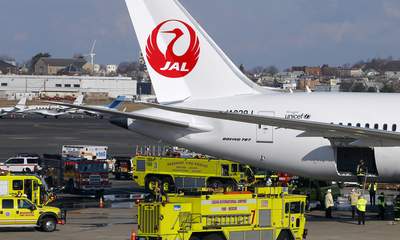
Boeing Dreamliner catches fire on runway

Boeing 787 Dreamliner Catches Fire In Boston

Scene of the incident


An electrical fire onboard a Boeing 787 aircraft has prompted further concerns for the Dreamliner's delayed introduction.

The Japan Air Lines jet filled with smoke after arriving at Boston, following a non-stop flight from Tokyo.

The fire chief Logan airport said a a fault occurred in the battery pack for the plane's auxiliary power unit, which runs the jet's electrical systems when it's not getting power from its engines.
Fire crews using infrared equipment found flames in a small compartment in the plane's belly and had the fire out in about 20 minutes, he said.
Massachusetts Port Authority's fire chief Bob Donahue said there was a flare-up later when a rechargeable battery exploded.

"Something caused this battery pack to overheat, ignite," Mr Donahue said, adding it was too soon to know the cause.

About 15 minutes after all 173 passengers and 11 crew members had disembarked a mechanic spotted light smoke in the cockpit and cabin.
"When we arrived, it was a heavy smoke, and that was in three minutes, so this was advancing," Mr Donahue said.

The model was originally planned for launch in 2009 but production has been beset with technical problems. It was first delivered in late 2011.

In November 2010, a test flight had to make an emergency landing after an in-flight electrical fire - delaying flight tests for several weeks while Boeing investigated.

Last month, a United Airlines 787 flying from Texas to New Jersey, diverted to New Orleans because of an electrical problem with a power distribution panel.

The head of Qatar Airways recently criticised Boeing after its delivery-delayed planes were grounded because of the electrical faults.

All the planes were grounded for at least five days and came as the US aviation watchdog discovered fuel line assembly errors.

It said that the faults could result in fire risk from leaks dripping on hot engine parts or causing the aircraft to run out of fuel.

The latest Dreamliner incident raises concerns for British Airways (BA), which has ordered 24 Dreamliners from Boeing.

BA is still expecting its first 787 in May, with a further three due for delivery before the end of 2013. Virgin Atlantic has 16 Dreamliners on order and told Sky News it still expects its debut delivery in 2014.
Thomson Airways has also placed orders for the hi-tech long-haul Boeing plane, which has been marketed as being more comfortable and environmentally friendly than other aircraft.

A spokeswoman for Thomson told Sky News: "Having checked with Boeing we have no reason to believe the delivery of our first 787 Dreamliner will be delayed.

"Our first Thomson Dreamliner is still on track to be delivered early this year. Boeing has reassured us that they are taking action to rectify the issues highlighted to them."

Wednesday, 22 August 2012

Virgin to take on British Airways at home

Virgin Altantic and British Airways logos (PA) 
Virgin to compete with BA on domestic routes

A snow plow clears snow on the tarmac at John F. Kennedy International Airport in New York, December 29, 2010. The snowstorm shut roads and canceled flights in New York City and created havoc across the Northeast. REUTERS/Jessica RinaldiLONDON (Reuters) - Virgin Atlantic will go head to head with rival British Airways (BA) on routes between London and Manchester next year after unveiling plans to make its first foray into the domestic short-haul market.

The airline, founded by serial entrepreneur Richard Branson in 1984, announced plans to operate three daily return flights from London's Heathrow to Manchester airport in northwest England from March 2013, providing competition to BA's short-haul service.

Virgin Atlantic claims that BA, part of IAG, operates a monopoly on the Heathrow to Manchester route after its takeover of UK carrier bmi this year.
"The airline believes competition on this route has been neglected in the remedy process and aims to provide choice for the 650,000 passengers who travel between the two cities," Virgin Atlantic Chief Executive Steve Ridgway said.

The new route will be Virgin's first move into domestic flights and will feed its long-haul services from Heathrow. It also plans to launch flights between London and Scotland in the future.
Ridgway added that about two thirds of people who fly from Manchester to London then connect to another long-haul flight; a market Virgin Atlantic wants a share of.

BA operates 17 return flights between London and Manchester, 13 of which are from Heathrow.
"We are pleased to see Virgin Atlantic increasing their presence in Manchester and to see competition returning on the London route," said Ken O'Toole, Manchester Airports Group's chief commercial officer.
Rivalry between Virgin Atlantic, which is part-owned by Singapore Airlines, and BA dates back more than 20 years to the so-called "dirty tricks" affair, when Virgin accused BA of conducting a smear campaign.
That ended with BA being forced to make a public apology and pay damages to Branson and Virgin. There have since been price wars, allegations of price-fixing and public rows over the size of passenger beds.
Virgin denied that the new service was a response to Virgin Rail being stripped of the West Coast Mainline franchise that covers London to Manchester.

Britain's Department for Transport last week awarded FirstGroup the 13-year franchise for the West Coast line, a decision Branson attacked as "insanity".
Virgin, which is applying for the 12 Heathrow take-off and landing slots that BA was forced to give up as part of the bmi deal, said it would use some of its existing slots to service the Manchester to London route.
Irish carrier Aer Lingus is also expected to bid for some slots to enable it to offer services between the Scottish capital Edinburgh and Heathrow. Applications for the slots are due by the end of this week.
Virgin plans to use leased Airbus A319 aircraft on the London to Manchester route.
BA was not immediately available for comment when contacted by Reuters.
(Editing by Paul Sandle and David Goodman)

Sunday, 20 May 2012

Heathrow Airport Taxis London Chauffeur: The real cost of budget air travel

Heathrow Airport Taxis London Chauffeur: The real cost of budget air travel: Ryanair vs British Airways: Why budget airlines cost more than standard airlines New report reveals low cost travel on easyJet ...

The real cost of budget air travel


Ryanair vs British Airways: Why budget airlines cost more than standard airlines


Is it worth being piled into a small cabin? (Fotolia)

New report reveals low cost travel on easyJet and Ryanair is actually more expensive for a typical family than with standard carriers.


Budget airlines cost you more on average (Image: Fotolia)

The whole point of low-cost airlines is that they save us money when compared to more standard carriers. Yet the opposite is true.

That’s according to a report from comparison site Idealo.co.uk which found that the average cost for a family on a no-frills flight with a budget airline is typically £29 more per seat compared with non-budget carriers.

Low-cost travel that isn't so low cost

The rise of low-cost travel has given many of us the opportunity to experience more of the world on the cheap.

But a backlash has raged for a few years now based on the sneaky surcharges budget airlines heap on, which bump up the price of your bargain holiday.

In general, flights booked by an individual can be cleverly executed to avoid a lot of the hidden costs, but when a family is involved there are just some things you cannot skimp on.

The research

The research from Idealo was based on a family of four with two parents, one child (between 2 and 11 years old) and one infant (under two).

The cost of a family flight was compared across 10 airlines over four popular short-haul flight routes out of London (Berlin, Barcelona, Palma Majorca & Alicante). The outbound flight was scheduled for Friday, July 13th and the return one on Monday, July 16th.

Of the 10 airlines analysed, four were low-cost carriers (EasyJet, Ryanair, Germanwings and Norwegian) and the other six (British Airways, Lufthansa, KLM, Air France, Air Berlin and Swiss) were standard carriers.

The reasonable criteria for a family to travel were established to consist of the following:

•    The two adults and child could each take one bag of 20kg.
•    The infant would be able to check one bag of 10kg.
•    The family will check one foldable pushchair and one car seat for the infant.
•    The family will guarantee that they can sit together.
•    The family will pay for the tickets with a credit card.

These bare minimum requirements (the report does not include things like food and drink or transfers from the airport) meant that a number of surcharges would likely be applied, unless they were already included in the advertised price. They included:

•    Baggage charges
•    Charges for priority boarding
•    Seat reservation charges
•    Infant fees
•    Credit card fees
•    Admin fees per passenger

The average cost is shown in the following table, with the cheapest first. The budget airlines are in bold:

Airline
Avg. Total Price
Avg. Price/Seat
Lufthansa
£701.71
£233.90
easyJet
£795.45
£265.15
British Airways
£817.38
£272.46
Swiss
£825.68
£275.23
Ryanair
£844.82
£281.61
Germanwings
£883.91
£294.64
Air France
£899.86
£299.95
Air Berlin
£946.59
£315.53
KLM
£976.76
£325.59
Norwegian
£1,270.87
£423.62
Source: Idealo.co.uk

As you can see the six non-budget airlines cost on average £29 a seat less than airlines that claim to save us money. For a family of four with an infant (which qualifies for free travel if under two) this amounts to £87 more than standard priced airlines.

In fact, Lufthansa, one of the largest airlines in Europe, did the best in terms of offering the best value for money whereas low-cost airline Norwegian was on average the most expensive way to travel as a family.

How can airlines that claim to be budget be costing us so much more money?


The real cost

Many of us realise through experience that the attractive advertised price is not the ‘real cost’ of flying with budget airlines. By the time you have booked your ticket, the add-ons really add-up.

Idealo's research points the finger at baggage as the main offender. It's not an easy area to cut down on either – in a typical family of four, on holiday for a few days, sticking to hand luggage just won’t cut it. Low-cost airlines charge an added premium whereas most other airlines give you a reasonable allowance of 20-23kg included in the price.

When the advertised cost was compared to the ‘real cost’ per seat, budget airlines did the worst. The difference per seat for non-budget airlines was on average just £18 or 7%.

However, the change was an astronomical £113.92 or 56% for budget airlines.

The worst offenders in the low-cost carrier line-up (surprise, surprise) were easyJet and Ryanair. While Norweigan and Germanwings saw a 24% and 33% mark-up on advertised prices, EasyJet and Ryanair dwarfed their low-cost peers charging a typical 92% and 166% more by the time you reach the ‘real cost’ of the flights at the checkout.

Lufthansa and Air France were the most transparent with hardly any change in the price by the time you came to paying for the flights. Lufthansa had a change on average of 0.2% (when an infant charge and credit card fees were applied) while Air France managed to achieve a decrease of 4% in the cost of the booking.

Airline
Avg. Cost / Passenger (Flight Search Engine)
Avg. ‘Real Cost’ / Passenger (including surcharges)
%Difference
Air France
£312.33
£299.95
-4%
Lufthansa
£233.50
£233.90
0.2%
KLM
£323.00
£325.59
0.8%
Swiss
£247.50
£275.23
11.2%
British Airways
£240.00
£272.46
13.5%
Air Berlin
£258.25
£315.53
22.2%
Norwegian
£343.00
£423.62
23.5%
Germanwings
£222.33
£294.64
32.5%
EasyJet
£138.25
£265.15
91.8%
Ryanair
£105.75
£281.61
166.3%
Source: Idealo.co.uk

Consumer behaviour

Despite the increased cost of budget airlines, there's still plenty of appetite for travelling with them. Indeed, easyJet saw an 8.9% increase in passenger numbers over the past 12 months.

Even though we have plenty of things to complain about, from surcharges and regional airports miles away from where we need to be, to bad service and cramped conditions we continue to reward these substandard carriers with our loyalty.

Does this mean that consumers are unaware of the real cost of budget airlines or that comparisons need to be more transparent?

As always not relying solely on comparison websites and shopping around for the best deal is key. 

Generally if you are happy to travel lightly, midweek, bring your own refreshments and are able to arrange transport from airports miles out of cities, then budget flights are worth it. But when you travel as a family just checking what the other side of airline travel can offer could surprise you.

Monday, 2 April 2012

Travelers promised to help fight jet lag by Headset

By Harriet Baskas
Jet lag.
It’s that disorienting, zombie-like condition that affects the circadian rhythm of travelers who fly across multiple time zones. Tourists may find themselves napping when all the museums and attractions are open and wide awake when everything is closed.
“We all have an internal sleep clock that controls things like hormones, mental function and attention,” said Gary Trock, M.D., co-director for Sleep Evaluation Services at Beaumont Hospital in Royal Oak, Mich. “And jet lag is caused by that clock being misaligned with our environment.”
Travelers attempt to fight jet lag with everything from over-the-counter and prescribed sleeping pills to herbal concoctions, melatonin, special diets, bright lights, exercise or by just forcing themselves to stay awake and moving when their bodies say “sleep.”
The delivery-system is a small device, designed by Finland-based Valkee, which looks like an iPod but has headphones that deliver light instead of music or sounds.
Business-class passengers on the airline’s flights between Helsinki and Shanghai will soon be asked to test bright light headsets that claim to help fight jet leg and reset circadian rhythms by delivering bright light to photosensitive regions of the brain through the ear canal.Now Finnair is conducting a test to see if passengers can alleviate jet lag by sticking light in their ears.
The light delivered by the device “brings about an element of well being that stimulates passengers and helps them to adapt better to jet lag and the fluctuation of the circadian rhythm,” the airline said in a statement.
During the one month test, set to begin at the end of March, passengers on Finnair’s eastbound flights to Shanghai will be instructed to use the light-emitting headsets about an hour before landing, when it’s early morning in Shanghai. Passengers headed west, toward Helsinki, will be told to use the Valkee about halfway through the flight, when it’s morning in Europe. Passengers who participate in the test will then be asked to fill out a questionnaire.
It sounds simple, but will it work?
“There is a pathway from our sleep clock to the retina,” said Trock, “and light at appropriate times can change the clock.” But although there is research being done on non-retinal photo receptors, he doesn’t believe that shining light on the brain can change the clock. “So until I see more data, I won’t be sticking this in my ear.”Although Valkee is classified as a medical device in Finland and there’s a page showing the results of clinical testing on the company website, sleep expert Trock said he’s seen nothing about the device in the scientific sleep journals, so he’s is very skeptical.
For now, Trock isn’t ruling out the possible placebo effect that the device, which costs €185 (about $243), might induce in those seeking to alleviate jet lag. But he said there are less expensive and more reliable ways to deal with the problem.  
If you’re due to arrive in another time zone in the daytime, Trock said a sleeping aid will help you sleep on the plane so that you’re not exhausted when you arrive.
“As a general rule, if you’re going from east to west, use a bright light in your hotel room or, better yet, get out in real sunlight to prolong your bed time.” When going the other way, Trock said a precisely timed dose of melatonin may help reset the sleep clock.
“But whatever you do,” said Trock, “your sleep clock will naturally reset itself in a few days.”